Freelance Salary Calculator: What Your Rate Is Really Worth
$75 an hour sounds like a six-figure life. After unpaid hours, expenses, fees and self-employment tax, it usually isn't. Here's how to work out the salary you're actually paying yourself — and the rate you'd need to match a job offer.
Updated July 30, 2026 · 7 min read
Freelance pricing strategist and founder of FreelancerMetrics. Helping independents charge what they're worth.
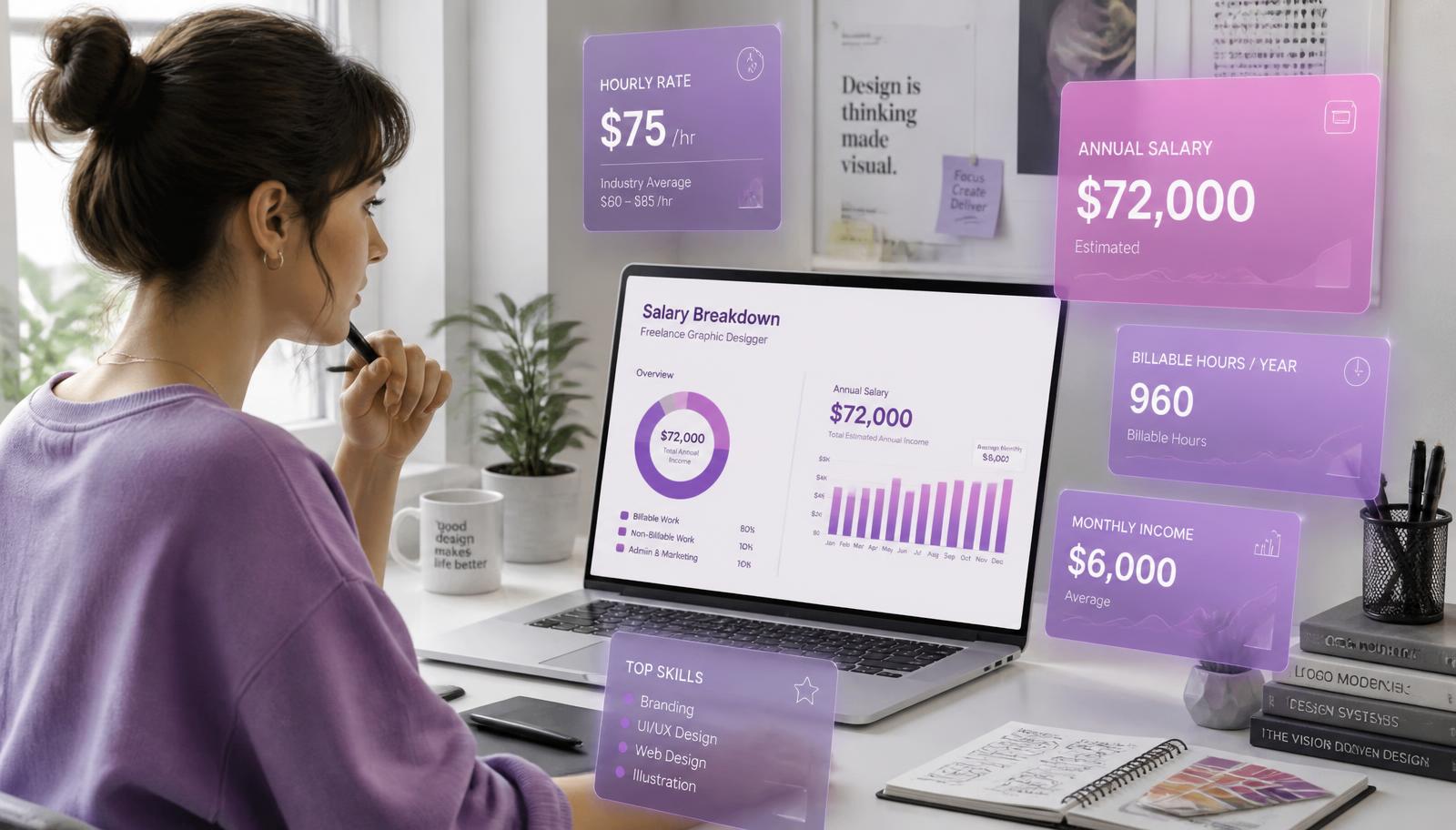
Short answer: multiply your hourly rate by realistic billable hours (1,000–1,500, not 2,080), then subtract 8–15% expenses, your platform fees, and 25–40% for tax and benefits. Most freelancers land 30–40% below their headline number.
Why freelance income isn't the same as a salary
An employed salary is a net promise: the company has already paid the payroll tax, bought the laptop, covered the health plan, and kept paying you through the fortnight you spent on a beach. Freelance revenue is a gross number with all of that still attached. Comparing the two directly is how people leave a $70,000 job for "$90,000 freelancing" and end up poorer.
The fix isn't pessimism, it's arithmetic. Work through the five steps below once, and you'll know the exact rate that makes freelancing pay better than employment for you.
How to calculate your freelance salary in 5 steps
- 01
Start with hours you actually bill
A full-time job is 2,080 hours a year. Freelancing isn't. Between pitching, invoicing, revisions you eat, and weeks nobody books you, most solo freelancers bill 1,000–1,500 hours. Use your own calendar from the last three months, not a hopeful number.
- 02
Multiply hours by your rate
1,200 billable hours at $75/hour is $90,000 of gross revenue. That's the number freelancers quote at parties — and it's the number that flatters you most, because nothing has been taken out yet.
- 03
Take out the cost of running the business
Software, hardware amortisation, insurance, accounting, a co-working desk, courses, and the odd subcontractor. Budget 8–15% of revenue. On $90,000 that's roughly $9,000 gone before you pay yourself anything.
- 04
Take out platform and payment fees
Upwork takes 10%, Fiverr up to 20%, agencies 20–40%, and payment processors 2–3% on top. If half your work comes through a marketplace, that's thousands of dollars that never reaches your bank account.
- 05
Take out tax and the benefits nobody gives you
Self-employment tax, income tax, your own health cover, unpaid holiday, unpaid sick days, and retirement contributions. An employer quietly funds all of it. As a freelancer you fund it out of the same pot — usually 25–40%.
Worked example: $75/hour is not a $90,000 salary
Here's the same freelancer at each stage of the calculation — 1,200 billable hours a year at $75 an hour, with average expenses and a half-marketplace client mix.
| Stage | Amount | What changed |
|---|---|---|
| Gross freelance revenue | $90,000 | 1,200 hours × $75/hr |
| After business expenses | $81,000 | −10% running costs |
| After platform & payment fees | $76,000 | −6% blended fees |
| Equivalent employed salary | ≈ $57,000 | after tax gap + unpaid benefits |
The headline said $90,000. The comparable job offer is closer to $57,000. To genuinely match a $90,000 salary, this freelancer needs roughly $115–$120 an hour — or more billable hours, fewer marketplace clients, and tighter expenses.
The reverse question: what rate matches the salary I want?
Flip the maths. Take the salary you want to take home, add your expenses, divide by one minus your combined tax-and-fee percentage, then divide by billable hours. A rough shortcut that lands close: target salary ÷ 1,000 billable hours × 1.4. A $80,000 target becomes about $112 an hour.
Our Target Income calculator does this properly, with your own expenses, tax rate and billable hours instead of a rule of thumb. If you sell fixed-price work, run the same number through Project Quote mode so your quotes stay consistent with your salary goal.
Five mistakes that quietly shrink your freelance salary
- !Billing against 2,080 hours a year — the fastest way to underprice by a third.
- !Forgetting self-employment tax until January, then treating it as a surprise instead of a cost.
- !Quoting marketplace clients the same rate as direct clients, so the platform eats your margin.
- !Never raising rates with long-term clients while your own costs rise every year.
- !Counting a good month as a monthly average — freelance income is seasonal; use a 12-month view.
Frequently asked questions
What is a freelance salary calculator?+
It's a tool that converts a freelance hourly or project rate into an annual salary figure you can compare with a full-time job offer. It accounts for billable hours, business expenses, platform fees, self-employment tax, and unpaid benefits like holiday and health cover.
Is a freelancer salary calculator different from a freelance salary calculator?+
No — "freelancer salary calculator" and "freelance salary calculator" describe the same tool. Both convert your hourly or project rate into a realistic take-home annual salary, so you only need to run the numbers once.
How do I convert my hourly rate to an annual salary?+
Multiply your hourly rate by realistic billable hours per year (usually 1,000–1,500, not 2,080), then subtract business expenses, platform fees, and self-employment tax. What's left is your true take-home salary.
What hourly rate equals a $100,000 salary?+
At 1,200 billable hours a year with roughly 30% going to expenses, fees, and the tax and benefits gap, you need about $120/hour to take home the equivalent of a $100,000 employed salary.
Why is a freelance rate higher than an employee's hourly wage?+
Because it covers everything an employer normally pays for: payroll tax, paid holiday, sick leave, health insurance, retirement contributions, equipment, software, and the unpaid hours you spend finding the next client.
How many billable hours should I plan for per year?+
Most sustainable full-time freelancers bill 20–30 hours a week across 46–48 working weeks — roughly 1,000 to 1,400 hours. Planning for 2,080 is the single most common reason freelancers underprice.
Should my freelance salary include unpaid admin time?+
Your salary comes only from billable hours, but admin time still has to be paid for. Cover it by raising your rate rather than by pretending those hours are billable.
How do I convert a full-time salary into a freelance rate?+
Divide the target salary by your realistic billable hours per year — usually 1,000 to 1,200, not 2,080 — then add 25 to 35 percent for tax, benefits and unpaid time. An $80,000 salary typically maps to a $90 to $110 hourly rate.
How many billable hours does a full-time freelancer actually work?+
Around 20 to 25 per week, or 1,000 to 1,200 per year after holidays. The remaining time goes to sales, admin, learning and unpaid revisions, and pricing as if it doesn't exist is the most common reason freelance income disappoints.
Is freelance income higher than an equivalent salary?+
Gross income is usually higher; take-home depends entirely on utilisation. Freelancers billing consistently at a proper rate typically out-earn the salaried equivalent by 20 to 50 percent, while those billing sporadically at employee-equivalent rates earn less.
How do I account for holidays and sick days in my freelance salary?+
Subtract them from your billable days first, then calculate the rate. Four weeks of holiday plus a week of illness removes about 10 percent of your capacity, so the rate has to be roughly 10 percent higher for the same annual income.
What benefits do I need to price into my freelance rate?+
Pension or retirement contributions, health cover, income protection, equipment replacement, software, accountancy and training. For most freelancers this totals 15 to 25 percent of target income and belongs in the rate, not in a hopeful note about next year.
Work out your real freelance salary
Enter your target income, expenses and billable hours — get the hourly rate and take-home salary that match, in seconds.
Open the salary calculator →Sources & methodology
Benchmarks in this guide come from public data and from anonymised rate and invoice figures shared by FreelancerMetrics users. Where a number is an estimate rather than a published statistic, it is labelled as such in the text. Primary references:
- 1Occupational Employment and Wage StatisticsU.S. Bureau of Labor Statistics
Median employed salaries by occupation, used as the baseline before freelance overhead is added.
- 2Employer Costs for Employee CompensationU.S. Bureau of Labor Statistics
Benefits as a share of total compensation — the gap freelancers must self-fund.
- 3Self-Employed Individuals Tax CenterIRS
Self-employment tax rate, quarterly estimated payment rules and deductible business expenses.
- 4Freelance Forward — annual independent workforce studyUpwork Research Institute
Freelance population, earnings mix and rate trends across skill categories.
Last reviewed August 4, 2026 by Javed Niamat. Tax and benefit figures are US-centric; check your local authority before filing.
About the author
Freelance pricing strategist · Founder, FreelancerMetrics
Javed spent a decade setting rates on both sides of the table — first quoting projects inside a digital agency, then running an independent practice. He now builds pricing tools used by freelancers in over 40 countries, and every guide here is based on real quotes, invoices and negotiations rather than recycled advice.
- 10+ years pricing freelance and agency work
- Reviewed 400+ freelancer P&Ls and rate cards
- Builder of the FreelancerMetrics rate calculators
- Writes only from first-hand client and invoice data